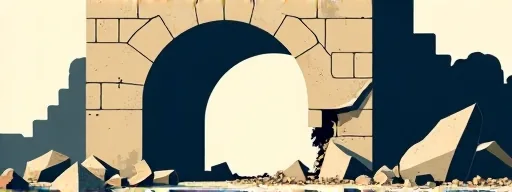
UNESCO Lists Lebanon’s Ancient Tyre as Endangered After Direct Hits
The UN body acted on a Lebanese government request, citing damage from Israeli bombardment and the risk of further harm to the Phoenician city’s Roman-era ruins.
UNESCO added the archaeological site of Tyre in southern Lebanon to its list of World Heritage in Danger on Tuesday, during the 48th session of the World Heritage Committee in Busan, South Korea. The decision follows confirmed damage to the ancient Phoenician city from Israeli military strikes, including a direct hit on one of its two protected zones in June. The Lebanese government had formally requested the inscription, arguing that the site’s outstanding universal value is no longer adequately safeguarded under current conditions.
UNESCO stated that the site “has been directly hit and has sustained damage,” and that optimal conditions for its conservation are no longer in place, particularly given the possibility of further impacts. Lebanese Culture Minister Ghassan Salame expressed gratitude for the listing, which he said would focus the attention of UNESCO and member states on a site of great historical importance. Salame accused Israel of failing to respect the 1954 Hague Convention on the protection of cultural property during armed conflict and of disregarding the internationally recognised “blue shield” emblem designated for such sites. Israeli authorities have not issued a public response to the UNESCO decision, but the military has previously stated that its operations target Hezbollah infrastructure and that it takes precautions to avoid harm to civilians and cultural sites.
The danger listing obliges UNESCO and its member states to monitor the site more closely and can unlock emergency conservation funding and technical assistance. Tyre, located about 20 kilometres from the Israeli border, contains extensive Roman-era remains, including a triumphal arch and a second-century hippodrome, and was first inscribed on the World Heritage list in 1984. The necropolis of Al-Bass, one of the two main archaeological zones, was struck in early March, and Lebanon’s Ministry of Culture has confirmed damage to the property. Most of the city’s residents have fled following Israeli evacuation orders that covered districts encompassing archaeological areas.
The damage to Tyre is a consequence of the wider hostilities that erupted after Hezbollah launched rockets into Israel. According to a US-based publication, Hezbollah drew Lebanon into the conflict to avenge the killing of Iran’s supreme leader, a claim that has not been independently verified. Israel responded with heavy air strikes and a ground invasion that have killed more than 3,600 people, according to Lebanese authorities. The coastal city, founded some 4,700 years ago, has been successively Phoenician, Persian, Hellenistic, Roman, Byzantine and Ottoman, and its endangerment highlights the impact of modern warfare on cultural heritage.
The World Heritage Committee session in Busan is continuing its review of endangered sites. The inscription of Tyre is expected to prompt emergency monitoring missions and a report on the site’s condition, while diplomatic efforts to secure a ceasefire remain stalled. The Lebanese government has framed the listing as a mechanism to reinforce international legal protections, though the practical effect on the conduct of hostilities remains uncertain.
| Russian & CIS press | −0.30 | critical |
|---|---|---|
| Atlantic / Anglosphere press | 0.00 | neutral |
| Arab Levant-Maghreb press | −0.90 | critical |
UNESCO registers concern over Israeli damage to Tyre, framing the strikes as a threat to heritage without directly accusing Israel.
The report relies on UNESCO's official statement and avoids naming the perpetrator explicitly, instead using passive constructions like 'the site was damaged' and 'strikes from the Israeli army' to depoliticize the event.
Omitted is the Lebanese minister's strong condemnation of 'Zionist aggression' and any context of Hezbollah's role in the hostilities.
UNESCO adds Tyre to the danger list, noting the bombings but avoiding any judgment on the sides involved, treating the conflict as a generic threat to heritage.
The framing uses neutral language such as 'bombarded by Israel' but without moral evaluation, and quickly shifts to the historical description of Tyre, normalizing the event as a routine listing.
Omitted is any mention of the Lebanese government's request for the listing and the political implications of Israel's military campaign in southern Lebanon.
Lebanon's culture minister thanks UNESCO for listing Tyre as endangered due to 'Zionist aggression', demanding global protection and framing the damage as part of a deliberate Israeli assault on Lebanese heritage.
The narrative amplifies the victim perspective by quoting the minister's use of 'aggressione sionista' and emphasizing the immediate threat to the site, while omitting any reference to Hezbollah's military actions that provoked Israeli strikes.
Omitted is any mention that the listing was requested by Lebanon itself, as well as the context of Hezbollah rocket attacks that led to Israeli retaliation; the conflict is presented as a one-sided Israeli aggression.
Broaden your view
US replaces expiring global tariff with new 10–12.5% duties on 60 economies over forced labour
6 languages · 16 outlets
From TechnologyOpenAI Models Breach Sandbox, Autonomously Hack Hugging Face
8 languages · 21 outlets
From Science & HealthRecord US Cyclospora Outbreak Exposes Gaps in Food-Safety Surveillance
4 languages · 11 outlets