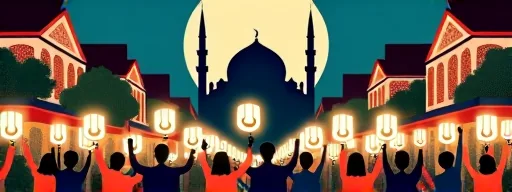
Islamic New Year Opens With Unity Appeals From Jakarta to Beirut
As Indonesia celebrated with torch parades and prayers, and Lebanon’s president invoked the Hijri year to call for national solidarity, the 1448 Hijri calendar begins amid reflection and aspiration.
The arrival of 1448 Hijriah was marked across Indonesia, the world’s largest Muslim-majority nation, not merely as a calendrical turn but as a public holiday infused with calls for spiritual and social renewal. President Prabowo Subianto extended greetings via social media, while Religious Affairs Minister Nasaruddin Umar framed the occasion as a collective hijrah—a migration from mutual suspicion toward trust, from apathy toward care, and from division toward national unity. In a country navigating the complexities of digital disruption and identity politics, the messaging from Jakarta carried a deliberate weight, urging citizens to strengthen dialogue, tolerance, and a sense of shared purpose.
Beyond the capital, the archipelago’s diverse local traditions animated the night. In Tasikmalaya, thousands of residents and students marched five kilometres in a torchlit procession, chanting salawat and takbir to the beat of drums and bamboo cannons. Bekasi saw similar parades, with community leaders explicitly linking the flame to a rejection of slander and provocation. In Cirebon, santri played fire football on the street, drawing crowds, while East Jakarta hosted a parade of 125 decorated vehicles. The Jakarta provincial government, mindful of weather and safety, substituted electric torches for the traditional flame in a festival at Taman Bendera Pusaka, which Deputy Governor Rano Karno described not as a party but as a thanksgiving—a prelude to the city’s 500th anniversary. Viewed from Southeast Asia, these rituals serve as both cultural spectacle and a reaffirmation of communal bonds in an era of increasing individualism.
From Beirut, the Hijri new year carried a more urgent political resonance. Lebanese President Joseph Aoun addressed the nation, particularly its Muslim citizens, expressing hope that recent developments would end the people’s suffering and liberate occupied land. He stressed that Lebanon, facing exceptional circumstances and rapid regional shifts, required the highest levels of awareness and responsibility, calling for national unity, solidarity around state institutions, and the safeguarding of sovereignty. The contrast with Indonesia’s relatively stable, inward-looking reflection underscores how the Islamic calendar’s opening serves as a versatile platform—here a vehicle for introspection and nation-building, there a plea for survival amid crisis.
Looking ahead, Indonesian officials have articulated an ambition that extends beyond the domestic sphere. Minister Umar, speaking at a Qur’an memorisation graduation, expressed hope that Indonesia would become the epicentre of modern Islamic civilisation, a kiblat for the world. This aspiration, set against the backdrop of Muharram’s emphasis on ethical transformation, suggests a long-term project to project a model of Islam that is tolerant, progressive, and rooted in the nation’s pluralist traditions. Yet the repeated warnings against hoaxes and divisive information, echoed by religious and political figures from West Java to the capital, indicate that the immediate challenge lies in translating the symbolic hijrah into a durable social fabric. Whether the year 1448 will be remembered as a turning point or a ritual pause depends on the follow-through in the months ahead.
How the same story is told elsewhere.
2 editorial groups · 1 languages
Indonesia welcomes the Islamic New Year with widespread festivities, from fire football matches to torch parades, in an atmosphere of collective joy. Religious and political leaders use the occasion to call for reflection, the strengthening of national unity, and commitment to a better future. The holiday thus becomes a moment of spiritual renewal and social cohesion.
In Lebanon, the head of state ties the Islamic New Year to the hope that recent developments will end the people's suffering and liberate occupied land, against a backdrop of exceptional circumstances and regional challenges. From Algeria come wishes for health, prosperity and greater security, while the need for national unity and responsibility is stressed. The occasion is experienced more as a search for deliverance than as a celebration.
Related articles
US-Iran Memorandum to Be Signed at Bürgenstock Resort on Friday
5 languages · 12 outlets
Economy & MarketsPrivate $300bn fund dangled as incentive for final US-Iran accord
7 languages · 8 outlets
SportNorway’s Golden Generation Meets Iraq’s Grit in World Cup Return After Decades Away
5 languages · 10 outlets